/grill-with-docsCreate shared understanding
Interrogate the idea, sharpen the project's language, and capture durable context before writing a specification.
Matt Pocock's current AI engineering workflow
The interesting shift is not a better prompt. It is a sequence of human decisions, durable artifacts, small executable slices, and independent feedback loops.
01 / Current spine
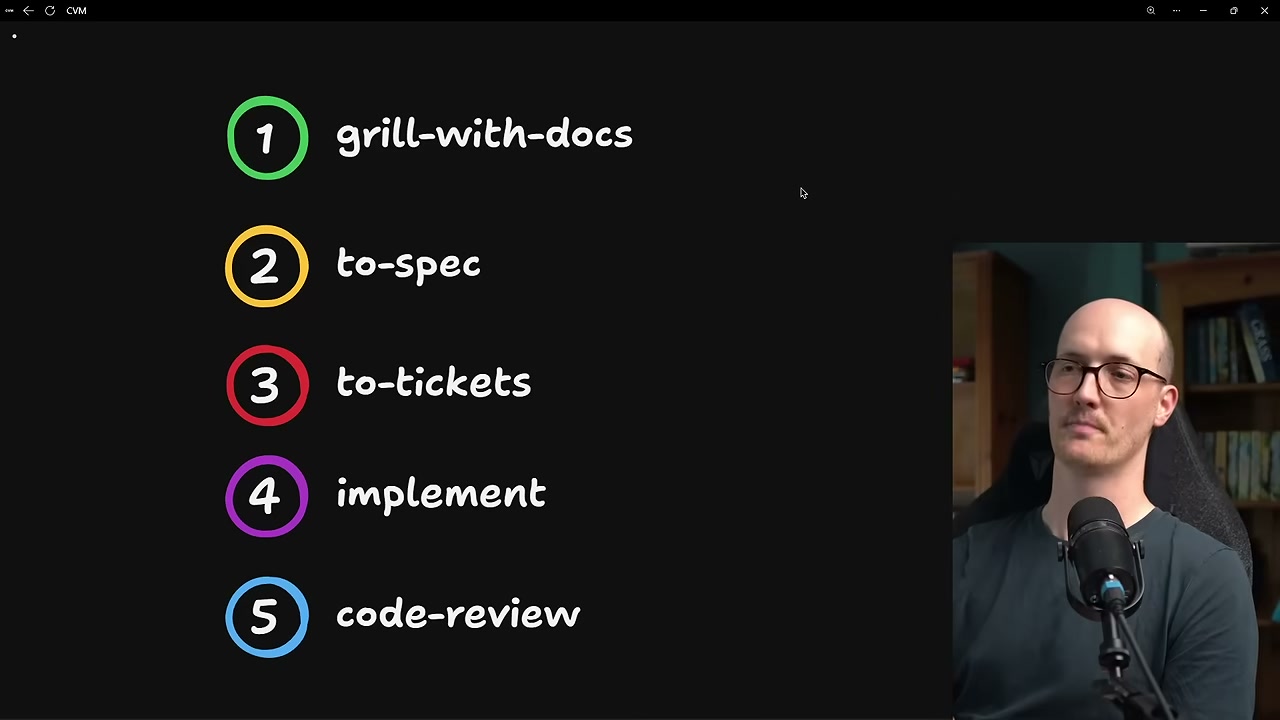
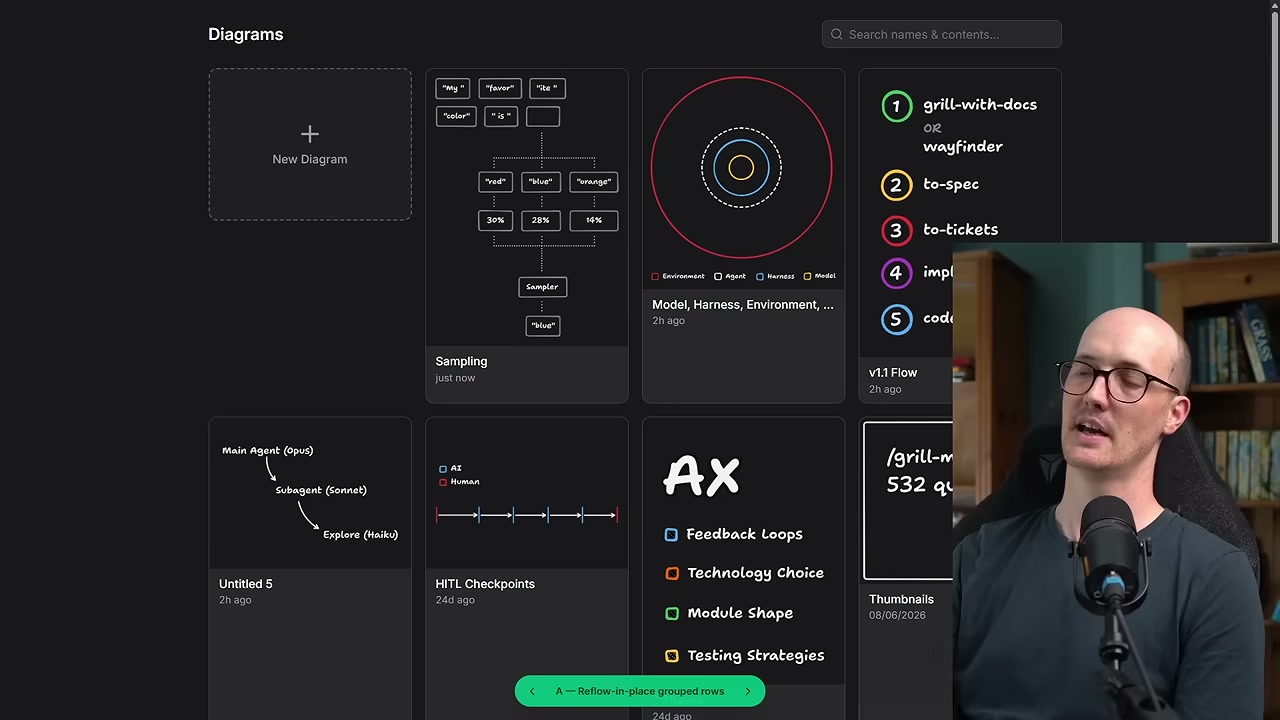
In Matt's July 2026 walkthrough, the everyday route is now grill-with-docs, to-spec, to-tickets, implement, and code-review. Wayfinder sits upstream when the work is too large or too foggy to specify in one session.
/grill-with-docsInterrogate the idea, sharpen the project's language, and capture durable context before writing a specification.
/to-specSynthesize the decisions already made. The specification records shared understanding instead of inventing it.
/to-ticketsTurn the spec into vertical tickets with explicit blocking edges, ready for sequential or parallel execution.
/implement + tddImplement one behavior at a time, with tests aimed at public interfaces and regular type and test feedback.
/code-reviewFresh agents check standards and spec fidelity separately, then human QA judges the product in use.
 08:23 ↗
The current main flow. The sequence keeps alignment, specification, slicing, implementation, and review as distinct jobs.
02 / What changed
The April workshop established the durable skeleton: shared understanding, vertical slices, TDD, fresh review, and human QA.
When words are too low fidelity, the agent builds an artifact to react to. The validated answer then becomes primary material for the spec.
It does not pre-slice an unknowable project. It advances only the visible frontier and lets later questions emerge from resolved ones.
Cheap prototypes turn taste and behavior into observable evidence.
03 / Wayfinder
A Wayfinder map is deliberately incomplete. It records the destination, indexes resolved decisions, exposes what can be decided now, and leaves still-vague territory as fog.
The decision, spec, or change the map is finding a route toward.
One precise question per child issue, sized to one agent session.
Open, unblocked, unclaimed tickets that are genuinely ready now.
In-scope questions that cannot yet be stated precisely enough to ticket.
Work consciously beyond this destination, closed so it never leaks onto the frontier.
What is most interesting
The map stores uncertainty honestly. It advances the boundary of the known instead of laundering fog into a confident checklist.
04 / John Rengwu
John Rengwu released wayfinder-maps after posting a planetary view of the process. The open-source tool reads a local Markdown adapter, reports frontier status, lints the map, and renders it as a star field.
Not just a skin
05 / Two layers
A shared issue-tracker map indexes decisions and child tickets.
Structured local Markdown owns the facts; the viewer is a read-only projection.
Keep one canonical graph. Treat every interface as a view, not a second database.
Native blocking links expose the frontier in the tracker's UI.
Gold stars, glow, position, and a status command make readiness spatial and immediate.
Machine-readable dependency edges should also be glanceable to a human supervisor.
The map stays low resolution and points to the ticket that owns each decision.
Status is derived from file content; lint behaves like fsck for the planning memory.
Avoid duplicated status, then verify the remaining contract continuously.
Scope, grilling, prototypes, and QA remain explicitly human-in-the-loop.
The planetary view compresses fleet state so a human can choose where to look next.
Automate navigation and evidence. Preserve judgment at high-leverage decisions.
06 / Recommended combination
The strongest synthesis adds Kun Chen's runtime after Matt and Rengwu's planning layer. Wayfinder decides what the work means; the star map makes readiness legible; FirstMate can dispatch only the implementation tickets that have genuinely cleared the frontier. Mycelium adds a distinct layer when those tickets need to become application code: an executable control-flow graph with schema-bound cells that agents can implement in bounded contexts.
Use Wayfinder for a foggy destination. Resolve research, prototype, and grilling decisions.
Render the map as a deterministic star field and lint it after every structural change.
When the route is clear, produce the spec and tracer-bullet implementation tickets.
Let FirstMate lease worktrees only for ready slices, preserving claims and dependency order.
Run TDD, two-axis fresh review, and human QA before delivery changes the shared truth.
Keep the decision map, execution state, and visual projection as separate contracts. Integration should pass references and events, not duplicate truth.
07 / Critical verdict
Interview before specification. Prototype where words are weak. Keep tickets vertical. Test through stable seams. Review spec and standards independently.
A heavy map is wasteful when one sharp session will do. Skills can conflict. Prototypes can seduce. Visual polish can disguise an incoherent graph.
Use automation to move evidence and state. Reserve human attention for scope, taste, architecture, and acceptance.